
Metal roof restoration can be a practical option for a commercial or industrial building in Ironton, OH when the existing roof is still a suitable base for repair and coating work. Cosam Contracting has served commercial roofing customers for decades and works on metal roofing systems across Ohio. Before recommending restoration, the roof should be evaluated for panel condition, seams, fasteners, corrosion, drainage, moisture concerns, and the preparation needed for the proposed coating system. Call 419-492-2201 to discuss a metal roof assessment.
Is Your Metal Roof a Good Candidate for Restoration?
A metal roof that is still structurally serviceable may be a candidate for restoration when deterioration is mainly at the surface and localized details can be repaired. The decision should not come from age alone. A contractor should look at whether the panels remain sound, whether seams and laps can be repaired, whether fasteners still provide reliable attachment, and whether the roof can be prepared for the selected coating system.
Restoration is often considered when coating breakdown, isolated corrosion, small leaks, or limited seam and fastener issues are present but the broader roof assembly remains serviceable. The existing metal roof still needs enough sound material and stable attachment to support the repair and coating work.
How Panels, Seams, and Corrosion Should Be Assessed
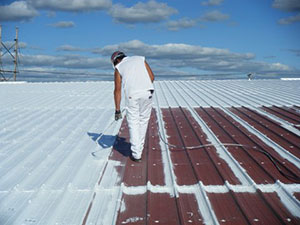
A restoration assessment should document where corrosion appears and how far it has progressed. Light surface oxidation or coating failure is different from metal loss, pinholes, perforation, or corrosion that has spread through the panel. Once the metal itself has thinned or failed, coating alone cannot rebuild the missing material.
Seams, laps, fasteners, flashing, penetrations, and transitions also need close review. Isolated sealant failure or backed-out fasteners may be repairable, while widespread seam separation, repeated fastener pull-through, or unstable panels can point to a larger problem. The contractor should distinguish conditions that can be corrected before coating from conditions that make restoration unsuitable.
Surface Preparation Is Part of the Restoration Scope
Coating performance depends heavily on the condition of the surface beneath it. Dirt, loose rust, failed coatings, oil, biological growth, and deteriorated sealant can interfere with adhesion. Preparation may include cleaning, rust treatment, removal of loose or incompatible material, seam and fastener repairs, and primer where required by the selected system.
The exact preparation method should follow the roof condition and the coating manufacturer’s written requirements. If an adhesion check or other compatibility step is required for the proposed system, that should be completed before the full coating application. A coating should not be applied simply to cover unresolved corrosion or failed details.
Moisture and Substrate Conditions Matter
Visible surface conditions do not always show what is happening below the metal roof. Recurring leaks, wet insulation, damaged decking, or other concealed deterioration can change the restoration decision. If moisture below the roof surface is suspected, the contractor should explain what additional investigation is appropriate and how the findings will affect the scope.
Restoration should not be used to trap known wet materials or conceal a substrate problem. Where damaged insulation, decking, or other supporting components are found, those conditions may require repair or replacement before any coating system can be considered.
When Restoration Cannot Substitute for Replacement
Restoration renews the protective surface and can address repairable seams, fasteners, and coating deterioration, but it does not restore structural capacity to failed metal. Replacement or more extensive panel work may be more appropriate when corrosion has penetrated the panels in multiple areas, attachment failure is widespread, panels are badly distorted or unstable, or repeated repairs have not resolved recurring problems.
The same is true when concealed damage extends beyond what can reasonably be corrected as part of a restoration scope. A useful recommendation should explain why the existing roof is still a suitable restoration candidate or why its condition has moved beyond that option.
What to Expect From the Restoration Proposal
A written proposal should identify the roof areas being restored, the existing conditions found, the repairs required before coating, the surface-preparation steps, and the proposed coating or restoration system. It should also explain how seams, fasteners, penetrations, and flashing will be treated and what conditions could change the scope once work begins.
Project timing depends on roof size, access, repair needs, preparation, weather, cure times, and product-specific application requirements. Rather than relying on a universal one-to-two-day timeline, ask for a schedule based on the actual roof and the selected system.
Metal Roof Restoration Experience
Cosam Contracting states that it began serving customers in 1985. Its company information describes decades of commercial roofing experience, while its current service pages include metal roofing, repair, replacement, coatings, and restoration. Experience is useful, but the restoration decision should still be based on documented roof conditions rather than a general claim that every aging metal roof can be restored.
Metal Roof Restoration in Ironton, OH
If you are considering metal roof restoration in Ironton, OH, start with a condition-based assessment of the panels, seams, fasteners, corrosion, moisture concerns, and substrate. The goal is to confirm that the roof can support the proposed restoration system before coating work begins.
Visit Cosam Contracting or contact the company and call 419-492-2201 to discuss the condition of your commercial metal roof.
Frequently Asked Questions
Does metal roof restoration add strength back to corroded panels?
No. Coatings can renew the protective surface after suitable repairs and preparation, but they do not rebuild metal that has thinned, perforated, or failed.
How do you decide whether a metal roof can be restored?
The decision should consider panel condition, seams, fasteners, corrosion, moisture concerns, substrate stability, surface preparation, and compatibility with the proposed restoration system.
Why does surface preparation matter before coating?
Loose rust, failed coatings, dirt, and deteriorated sealant can interfere with adhesion. Preparation should match the roof condition and the selected system’s written requirements.
How long does metal roof restoration take?
Timing depends on roof size, access, repairs, preparation, weather, cure requirements, and the coating system. A project-specific schedule is more reliable than one universal timeframe.