
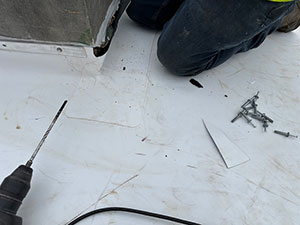
Commercial roof repair in Marion, Ohio should start with evidence about the roof condition, not with a repair method chosen from the ground. A leak inside the building can come from seams, flashing, penetrations, membrane damage, or other roof details, and water can travel before it becomes visible indoors. Cosam Contracting serves North and Central Ohio from its commercial roofing operation. Call 419-492-2201 to discuss a Marion roof evaluation.
Commercial Roof Repair Process
The first step is diagnosis. A professional commercial roof inspection should document the visible defect, surrounding roof condition, drainage, seams, flashing, penetrations, previous repairs, and any evidence that moisture may extend beyond the obvious problem. Additional moisture investigation may be appropriate when concealed conditions are suspected, but an interior stain by itself does not prove the entry point or the extent of wet materials.
Once the likely defect and surrounding conditions are understood, the repair scope can be defined. A contained seam opening, puncture, or flashing defect may support a localized repair when nearby materials remain serviceable. Repeated leaks, several unrelated problem areas, widespread deterioration, or uncertain substrate conditions can justify a broader assessment before more repair work is approved.
If permanent work cannot be completed immediately because of weather, access, material availability, or another project constraint, temporary weather protection may be appropriate. The temporary measure should be documented separately from the permanent repair so the owner knows what still needs to be completed.
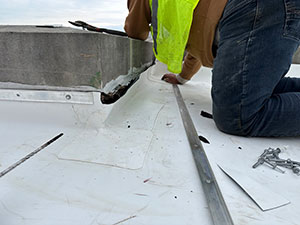
Why Commercial Roof Repair Scopes and Costs Differ
Two proposals can describe the same leak but price very different work. The useful comparison is not the total alone. It is what each contractor has confirmed, what is included, and what conditions could change the scope.
| Scope Factor | What to Confirm | How It Can Affect Cost |
|---|---|---|
| Damage extent | Whether the defect is localized or appears across multiple roof areas. | A contained repair generally involves less labor and material than a broader repair area or additional investigation. |
| Existing roof system | Which membrane, metal, coating, flashing, or other roof components are actually present. | Repair methods, preparation, compatible materials, and labor requirements vary by system. |
| Concealed conditions | What is known about insulation, substrate, moisture, and previous repairs, and what remains unverified. | Additional wet or deteriorated materials can expand the work after the roof is opened or further testing is completed. |
| Access and protection | How crews and materials reach the roof and what occupied areas, equipment, or operations need protection. | Difficult access, staging, and operational constraints can add labor, equipment, or coordination requirements. |
| Temporary versus permanent work | Whether the proposal is for temporary stabilization, permanent repair, or both. | A lower temporary-service price should not be compared as though it includes the complete permanent repair. |
Material Compatibility Matters
Repair materials need to be compatible with the roof already in place and with the specific detail being repaired. Sealants, coatings, patches, primers, fasteners, and other components are not automatically interchangeable. The proposal should identify the repair method and any preparation required rather than relying on a general statement that the contractor will use a high-quality product.
This is also where repair history matters. If the same area has been treated several times with different materials, the contractor may need to evaluate those prior repairs before adding another layer or patch.
What Should Be Included in the Repair Proposal?
A useful proposal should identify the repair location, confirmed condition, planned method, preparation, access needs, important exclusions, and how added work will be approved if concealed damage is discovered. It should also distinguish temporary work from permanent work and explain whether follow-up inspection or monitoring is part of the scope.
After the repair, closeout documentation can include photos, the repaired location, the work performed, any approved changes, and conditions that still need monitoring. If warranty or guarantee terms are offered, review the actual written terms rather than assuming every future leak or nearby roof condition is covered.
Repair, Maintenance, or a Broader Roofing Decision?
Prompt repairs and ongoing commercial roof maintenance can help owners address developing problems before they become harder to manage, but no maintenance program can guarantee that a roof will avoid future leaks or replacement.
If inspection evidence shows deterioration or moisture well beyond the repair area, it may be useful to compare continued repair with a broader project. Cosam’s commercial roof replacement information for Marion provides a separate reference for that larger decision. Replacement should not be assumed from age or a single leak alone.
Commercial Roof Repair in Marion, Ohio
The best way to compare commercial roof repair costs is to compare equivalent scopes. Confirm what was diagnosed, what repair is included, what remains unknown, how compatible materials will be selected, what access or protection is required, and how scope changes will be handled.
Contact Cosam Contracting or call 419-492-2201 to discuss commercial roof repair in Marion, Ohio.
Frequently Asked Questions
Why can two commercial roof repair quotes be very different?
They may cover different repair areas, investigation, materials, access, temporary work, exclusions, or concealed-condition assumptions. Compare the written scopes before comparing totals.
Can an interior ceiling stain show exactly where the roof is leaking?
No. Water can travel before it appears indoors, so the roof entry point and moisture extent need to be investigated separately.
What should I confirm before approving a repair proposal?
Confirm the repair location, method, preparation, exclusions, access requirements, temporary work, and how added work will be approved if concealed conditions are found.
When should a repair lead to a broader roof assessment?
Recurring leaks, multiple problem areas, widespread deterioration, or evidence that moisture extends well beyond the visible defect can justify a broader assessment.