
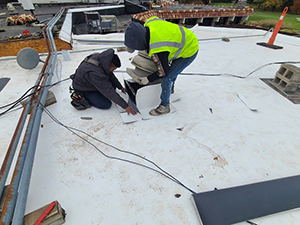
A commercial roof problem should be evaluated before the repair scope is set. A visible leak, stain, open seam, damaged flashing detail, or puncture may point to a localized defect, but the surrounding membrane, insulation, substrate, drainage, and nearby roof details determine whether a limited repair is enough or a broader assessment is needed.
Cosam Contracting provides commercial and industrial roofing services in Ohio and Kentucky and has worked in commercial roofing since 1985. For a building owner considering commercial roof repair, the useful first step is to document the symptom, inspect the roof system, and define what the proposed repair includes before work begins.
Extensive Evaluation of Your Roof
A thorough roof inspection should separate the symptom seen inside the building from the roofing condition that caused it. An interior stain confirms that moisture reached the occupied space, but it does not identify the exact entry point or show how far water may have moved within the roof assembly.
The evaluation can include seams, flashing, penetrations, drainage areas, previous repairs, visible membrane damage, and accessible evidence of moisture. If concealed conditions may affect the scope, the contractor should explain what remains unknown and whether further investigation is needed before a repair recommendation can be finalized.
Is It a Simple Repair, or Does It Need a Broader Look?
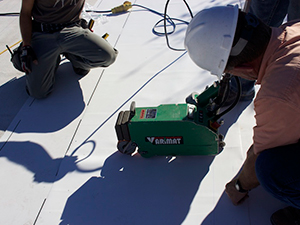
The same visible symptom can lead to different repair decisions depending on what the inspection finds. The following evidence helps define whether the problem appears limited or whether more of the roof needs to be assessed.
| Condition to Check | Evidence to Confirm | Why It Changes the Scope |
|---|---|---|
| Seams | Whether separation is limited to one location or appears at several seams, and whether surrounding material remains serviceable | One defined defect may support a localized repair, while repeated seam problems can justify a broader review |
| Penetrations | Condition around vents, pipes, curbs, rooftop equipment, and the roofing immediately adjacent to those details | A visible opening may be only one part of a penetration detail that needs repair |
| Flashing | Whether wall, edge, curb, or transition flashing is open, displaced, deteriorated, or affected beyond one point | The repair should address the full affected detail rather than only the first visible gap |
| Moisture extent | What is known about moisture beneath the surface and whether further investigation is needed to define its extent | Moisture extending beyond the visible defect can expand the work beyond a simple surface repair |
A localized repair is easier to justify when the defect is clearly defined and surrounding materials remain serviceable. A broader assessment is more appropriate when similar defects appear in several areas, moisture may extend beyond the visible opening, or deterioration affects multiple roof details. A stain alone cannot prove or disprove concealed damage.
What a Commercial Roof Repair Quote Should Include
A repair quote should identify the area being addressed, the repair method or materials, preparation, relevant flashing or seam work, exclusions, and how additional conditions discovered during the work will be handled. If moisture investigation, insulation replacement, substrate work, drainage correction, or other related work is outside the quoted scope, that should be clear before the project starts.
Access planning should also match the building. Rooftop equipment, loading areas, entrances, occupied spaces, and site restrictions can affect how crews reach the work area and how materials are staged. If lifts, scaffolding, temporary protection, or coordination around building operations are needed, the proposal should state what is included rather than assuming the same setup applies to every property.
Advanced and Long-Lasting Commercial Roof Repair
Commercial roof repair should use methods and materials compatible with the existing roof system and the defect being corrected. Cosam’s leak repair service provides a related path when water entry is the immediate concern, while the inspection should still establish whether the issue is localized or part of a wider condition.
Repair does not guarantee that a roof will never leak again or that every aging condition has been corrected. The useful outcome is a defined scope tied to the evidence found, with clear documentation of what was repaired, what remained outside the scope, and what should be monitored afterward.
Safe Access Matters
Commercial roof inspection and repair are not do-it-yourself tasks. Roof edges, openings, wet surfaces, equipment, and changing conditions can create fall hazards, and the roof system itself can be damaged by uncontrolled access. Building owners can document interior symptoms and observations from safe areas, but rooftop diagnosis and repair should be handled by trained roofing personnel using appropriate access and fall-protection procedures.
Contact Us Today!
If a commercial roof shows signs of leakage, seam separation, flashing damage, or another defect, the next step is to determine how far the problem extends before choosing the repair. Cosam Contracting serves commercial and industrial properties in Ohio and Kentucky and can evaluate the roof condition, explain the proposed scope, and identify when a localized repair is appropriate or when broader assessment is needed.
Frequently Asked Questions
How do I know whether a roof problem can be repaired locally?
A localized repair may fit when the defect is clearly defined and surrounding materials remain serviceable. Repeated defects, broader deterioration, or moisture beyond the visible area can require a wider assessment.
Does an interior stain show exactly where the roof is leaking?
No. Water can move within a roof assembly before it appears inside, so the stain is evidence to investigate rather than proof of the exact entry point.
What should a commercial roof repair quote explain?
It should identify the repair area, method or materials, preparation, relevant detail work, exclusions, access requirements, and how newly discovered conditions will be handled.
Can building staff inspect commercial roof damage themselves?
Staff can document symptoms from safe locations, but rooftop inspection and repair should be handled by trained personnel with appropriate access and fall-protection procedures.